

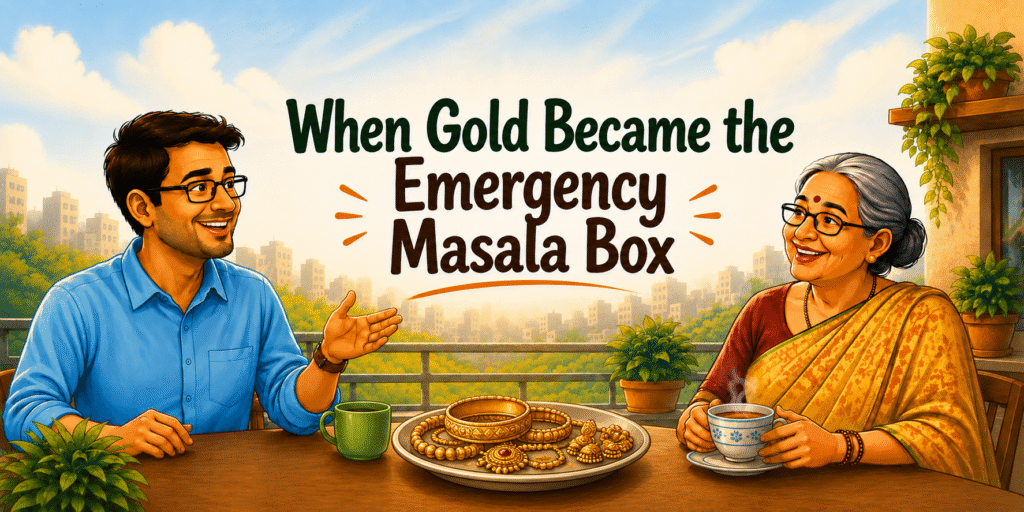
When Gold Became the Emergency Masala Box
What if your gold could help you access money without actually selling it?
My cousin had some gold at home.
He wanted to keep it in a bank locker. But the locker cost was high, so he chose a Gold Overdraft instead.
Aai looked puzzled.
“Gold overdraft? Gold ko loan pe bhej diya?”
“Not exactly.
You pledge the gold as collateral. The bank gives you an overdraft facility against it, which you can use when needed.
And generally, interest is charged on the amount you actually use, rather than the entire sanctioned limit.
Aai thought for a moment.
“Matlab bank ne gold ke badle ek financial dabba de diya?”
“Exactly.
Think of it like an emergency masala box.
You don’t use all the masala every day.
But when you need it, it’s there.”
“Toh ₹5 lakh ki limit li aur kuch use nahi kiya?”
Gold Overdraft in one line:
You pledge eligible gold as collateral, receive an approved credit limit, and can draw money from that limit when required. The facility comes with interest and other applicable charges, and your pledged gold is at risk if the borrowing isn’t repaid as agreed.
“Generally, if you don’t use the facility, you don’t pay interest on the unused amount. But there can be processing, renewal and other charges.”
Aai nodded.
“Aur locker?”
“Locker solves a storage problem.
A Gold OD solves a liquidity problem.”
She smiled.
“Mhanje ek mein gold safe rehta hai. Doosre mein gold kaam karta hai.”
“Exactly.”
But there is one important catch.
A Gold OD is borrowing, not free money.
The gold is pledged as collateral. If the borrowing isn’t repaid as agreed, the pledged gold can ultimately be at risk.
Aai took a sip of tea.
“Samjha. Gold ko idle rakhna alag. Gold ko collateral banana alag.”
Exactly.
Kitchenomics Takeaway
A locker gives gold a place to stay.
A Gold OD gives gold a job to do.
But before putting an asset to work, understand its cost, risk and exit plan.
Aai smiled.
“Bas masala dabba bank ke paas ho, toh tadka time pe milna chahiye.” 😄