

The flight from Bengaluru to Pune started with a warning.
“We may experience some turbulence.”
Fair enough.
I was reading Verity and mentally prepared for a few crooked underlines in the book.
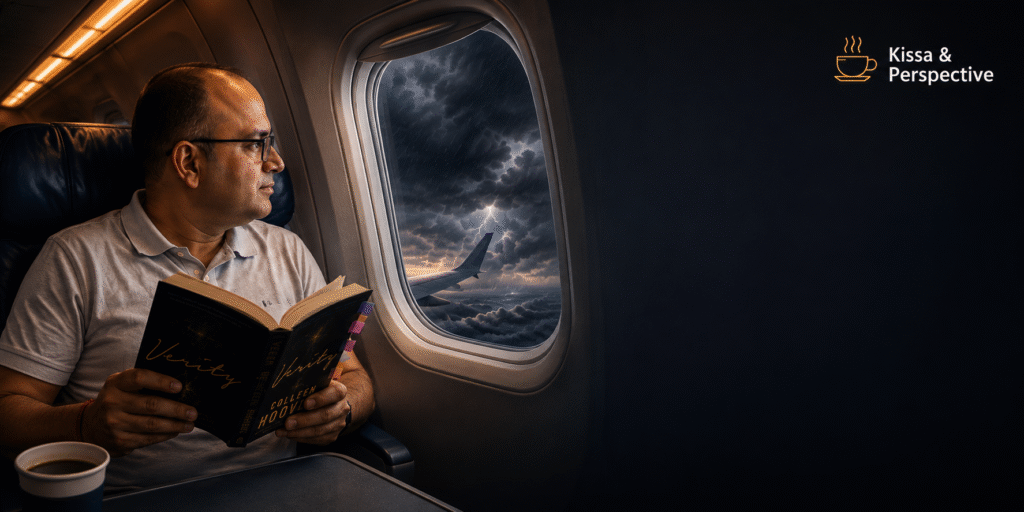
What I wasn’t prepared for were the crooked thoughts.
The turbulence wasn’t severe, but it wasn’t mild either. It stayed with us for almost a third of the flight.
Initially, I was calm.
Then the bumps kept coming.
The seat belt stayed on.
The cabin grew quieter.
A few passengers looked uncomfortable.
And somewhere between the next chapter and the next air pocket, a familiar thought arrived:
Will I be okay?
The funny thing was that I kept reading.
The book was too engaging to put down.
The sentences remained steady.
My mind did not.
A thriller was unfolding in my hands.
Another one was unfolding in my head.
The book was asking questions about truth, motives and deception.
My mind was asking simpler questions.
How much longer?
Is this normal?
Why does the next bump always feel bigger than the last one?
I tried underlining a few passages.
The lines came out shaky.
So did the thoughts.
And that’s when I noticed something.
When we hear the word turbulence, we think about the plane.
Rarely do we think about the turbulence inside our own heads.
The stories we create.
The possibilities we imagine.
The conclusions we jump to.
The plane eventually landed in Pune.
The passengers relaxed.
The underlines remained crooked.
But the bigger takeaway wasn’t in the book.
It was in my reaction.
The weather outside had been turbulent for thirty minutes.
The weather inside my head had been worse.
☕ What affects you more—the turbulence outside or the turbulence inside?