

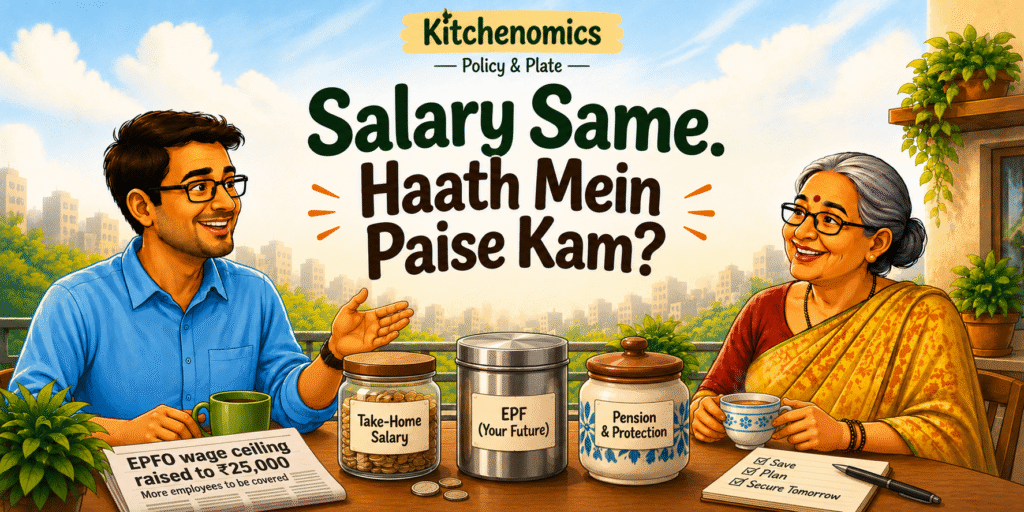
Aai was looking at the news when she asked:
“Salary same ho aur haath mein paise kam aaye, toh usko kya bolte hain?”
I laughed.
“Normally? Problem.”
“Aur government kare toh?”
“Social security.”
The Union Cabinet has approved raising the EPFO wage ceiling from ₹15,000 to ₹25,000 a month for mandatory coverage. The government expects this to bring more than 51 lakh additional employees under mandatory EPFO coverage. The revised ceiling is set to take effect from 17 September 2026.
Aai was still stuck on one thing.
“Par salary same hai. Phir haath mein paise kam kaise?”
I pointed towards the kitchen.
“Aai, suppose every month I give you 10 kg rice.”
“Okay.”
“Earlier, you kept 8 kg in the kitchen and 2 kg in the godown for later.”
“Hmm.”
“Now imagine that someone who earlier didn’t have to keep rice in the godown is now required to keep some there.”
She immediately said: “Rice toh utna hi hai. Bas ab uska kuch hissa future ke liye rakhna padega?”
Exactly. That’s the simplest way to think about the trade-off.
Paisa gaya nahi.
Kuch paisa ab future ke godown mein jaana padega.
And EPFO isn’t only about the PF balance.
The framework also includes pension through the Employees’ Pension Scheme (EPS) and insurance through the Employees’ Deposit Linked Insurance Scheme (EDLI), subject to the applicable rules.
Aai thought about it.
“Matlab aaj ki sabzi ka budget thoda chhota, future ka ration thoda bada?”
“That’s one way of looking at it.”
Then came the inevitable question.
“Toh ceiling badhi hai… salary nahi?”
“Correct.”
She smiled.
“Government bhi na. Bachat karwane ka tareeka bilkul maa jaisa hai.”
“How?”
“Pehle paise side mein rakho. Jo bachega, usmein mahina chalao.”
Kitchenomics Takeaway
The EPFO wage ceiling has moved from ₹15,000 to ₹25,000 for mandatory coverage. The change is expected to extend statutory social-security coverage to more than 51 lakh additional employees.
Behind the technical policy change is a simple idea:
For newly covered employees, some money may now be set aside for tomorrow instead of coming entirely home today.
The trade-off is visible today.
The security is meant for later.
Or, as Aai would put it:
“Aaj ka dabba thoda chhota. Future ka godown thoda bada.”