Kitchenomics – Policy & Plate
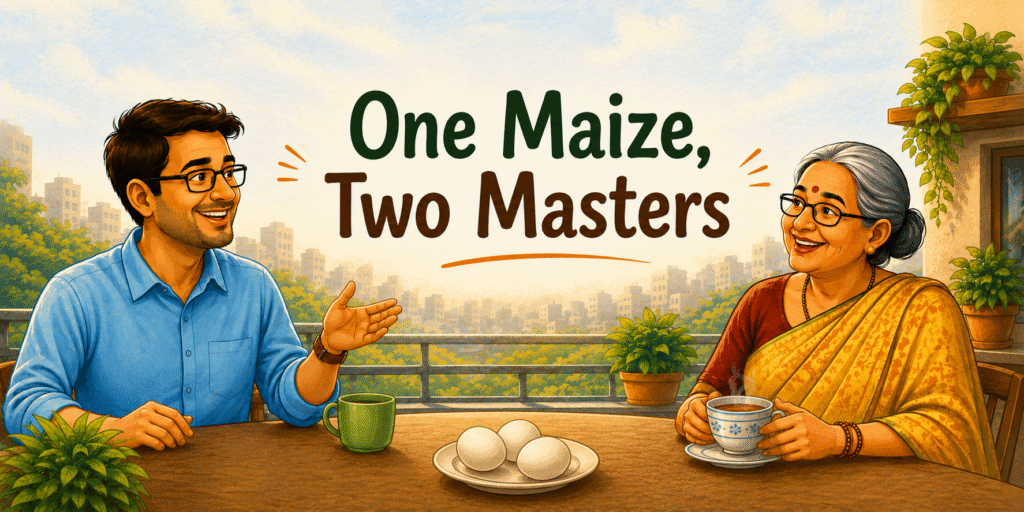
One morning, Aai was making an omelette and looking at the egg tray.
Aai: “Arre, ande phir mehange ho gaye? Murgi ne salary hike maangi kya?”
Me: “Nahi Aai. Murgi ka khana mehanga ho gaya.”
She looked at me.
“Murgi ka khana aur ande ka kya connection?”
Me: “Poultry feed mein maize — makka — important ingredient hai.”
“Makka mehanga, feed mehanga, aur feed mehanga, toh anda mehanga.”
Aai nodded.
“Accha. Par makka mehanga kyun?”
I smiled.
“Kyunki makke ka ek aur bada customer aa gaya hai.”
Aai: “Kaun?”
Me: “Petrol.”
Aai: “Petrol makka khaata hai?” 😄
Me: “Indirectly, Makke se ethanol banta hai, jo petrol mein blend hota hai.”
“Toh ab poultry farms aur fuel industry — dono ko makka chahiye.”
Aai laughed.
“Matlab ek taraf murgi bol rahi hai — ‘Mujhe khana do.'”
“Aur doosri taraf gaadi bol rahi hai — ‘Mujhe fuel do.'”
“Exactly.”
One maize. Two masters.
🍽️ The Kitchenomics Takeaway
Sometimes, the price of what we eat isn’t decided in the kitchen.
It’s influenced by what else the world wants from the same ingredient.
Because in the end,
“Ek hi makka, do masters… aur bill hamare kitchen mein.”
This is the sweet spot for Kitchenomics: one everyday observation → one unexpected economic connection → one line that makes the reader see the ordinary differently.**